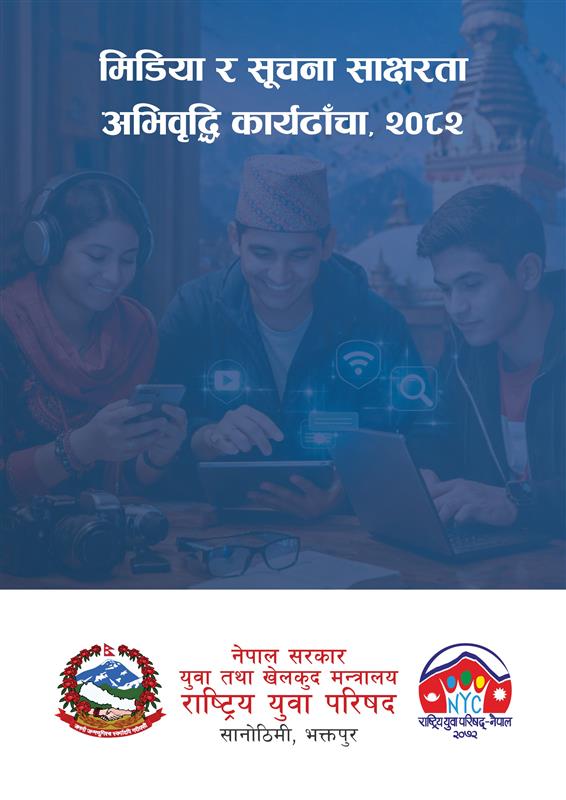
Kathmandu, 17 February 2026 – The National Youth Council, in collaboration with UNESCO and Youth Innovation Lab, and following extensive consultations with relevant government institutions, youth-focused organizations, and technical expert, has officially launched the “Media and Information Literacy Enhancement Operational Procedure, 2082.”
The operational procedure was endorsed on 1 January 2026 by the Vice-Chairperson level of the National Youth Council. It aims to help empower young Nepali citizens and build their skills so they can respond to the fast-changing challenges of the digital world, while ensuring a safe and active civic space. The procedure is based on experiences, needs, and recommendations of young Nepalis and organizations, working with or led by youth. It offers practical guidance to help youth and youth-led and youth-focused organizations to take informed decisions, adopt ethical practices, and effectively address issues such as misinformation, disinformation, online harassment, and cybersecurity threats etc.
Highlighting the intent of the operational procedure, Mr. Gehanath Gautam, Administrative Chief of the National Youth Council, stated that through this operational procedure, the Council seeks to promote the responsible flow of information in Nepal’s digital space. He emphasized that the procedure is designed to enable citizens to access, understand, assess, and ethical use digital platforms, while strengthening their capacity to identify, counter, and protect themselves from the unnecessary spread of false and misleading content. He further noted that the procedure is expected to contribute both to informed use of digital information and to safeguard citizens and society from misinformation.
Echoing this perspective, Mr. Jaco du Toit, UNESCO Representative to Nepal, noted that inspired by Global MIL Week in Colombia in 2025, Nepal is accelerating media and information literacy so that every young person can engage online with skill and integrity.
Background and Rationale
Developed in line with the spirit of the National Youth Council Act, 2072 and the National Youth Policy, 2082, this procedure aims to strengthen the role of youth in building a knowledge-based society. With the increasing use of the internet and digital media, the associated risks have also grown. Therefore, developing youths’ critical thinking skills, media and information literacy, digital skills, and responsible information consumption capacity has become essential, making this procedure highly significant.
Key Features of the Operational Procedure
The operational procedure focuses on three major dimensions of media and information literacy:
- Media Literacy – Developing the ability to understand various media platforms and evaluate the purpose and credibility of content.
- Information Literacy – Skills to identify reliable sources, distinguish misinformation, and use factual information.
- Digital Literacy – Safe use of digital tools, cybersecurity awareness, protection of personal data, and responsible online behavior.
Key Objectives
- Facilitate youth-focused organizations in enhancing media and information literacy
- Support protection from misinformation and disinformation while promoting the free flow of reliable information
- Raise awareness among youth about personal data privacy and digital security
- Strengthen coordination and collaboration between government and non-government institutions to advance the right to information.
Target Groups and Implementation
The operational procedure targets provincial and local youth councils, youth-focused organizations, and government and non-government bodies working in the youth sector. During implementation, special priority will be given to women, marginalized communities, and youth of gender and sexual minority, ensuring digital inclusion remains central.
Implementation Strategy
To ensure effective implementation, activities will include institutional capacity building, Training of Trainers models, promotional and awareness programs, fact-checking campaigns, and digital security workshops. Active participation of diverse target groups will be ensured through both virtual and physical approaches.
Monitoring and Evaluation
Program effectiveness will be assessed through a regular monitoring and evaluation system using S.M.A.R.T. indicators. Relevant organizations are required to submit annual reports to the National Youth Council.
This operational procedure is expected to serve as a historic and guiding document in promotion and institutionalization of media and information literacy in Nepal. It will make a significant contribution to building a knowledge-based society and contribute towards transforming into a technology-friendly nation. At its core, the operational procedure will promote safe, responsible, and pluralistic positive digital participation among youth.
Fully aligned with the National Youth Policy, 2082, the operational procedure will be effectively implemented at provincial and local levels.