By naveensanchar online
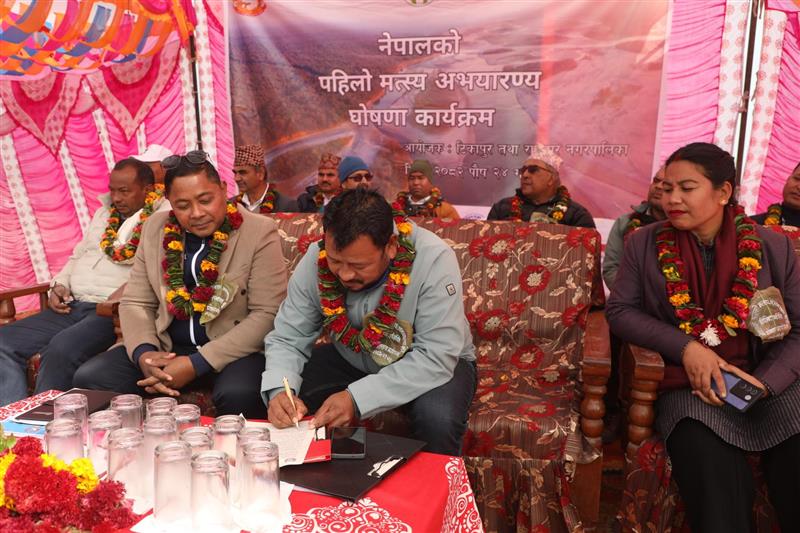
Tikapur, Kailali: In a landmark initiative for freshwater biodiversity
conservation and sustainable fisheries management in Nepal, Rajapur Municipality and
Tikapur Municipality have jointly declared Nepal’s first Fish Sanctuary, named ‘Sakhi Fish
Sanctuary’ in the Lower Karnali River on January 8th, 2026, through a formal public
declaration event held in the presence of local government leaders, community
representatives, government line agencies, and development partners.
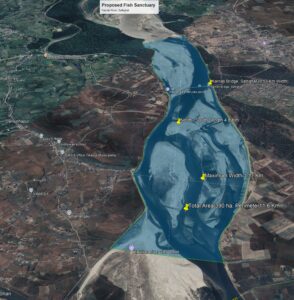
The Fish Sanctuary covers approximately 3.9 sq. km (390 hectares), with boundaries
extending from Southern Tedhiya, Rajapur-3, and Chhediya, Rajapur-4, to Arnahawa
Phanta, Tikapur-8, within the territorial jurisdictions of both municipalities. The declared
river sections have been identified as ecologically significant areas, serving as critical
breeding, spawning, and nursery habitats for indigenous fish species, and providing
essential habitat for nationally and globally important aquatic fauna, including the
Gangetic River Dolphin (Platanista gangetica), Gharial (Gavialis gangeticus), and Smoothcoated Otter (Lutrogale perspicillata).
“This sanctuary is a decision jointly initiated, endorsed, and fully owned by Rajapur and
Tikapur Municipalities. It reflects our responsibility to lead conservation from the ground
up, guided by the voices of our river-dependent communities. This is a decision taken by
the people of Rajapur and Tikapur for our own future”, remarked Mayor Ram Lal Dangaura
Tharu of Tikapur.
The Fish Sanctuary has been declared in accordance with the Aquatic Animal and
Biodiversity Conservation Act of the local governments, based on decisions duly endorsed
by the Municipal Executives of Rajapur Municipality and Tikapur Municipality, following the
principles of Free, Prior and Informed Consent (FPIC) and the issuance of public notices in
the respective municipal wards.
“By taking full municipal ownership of this declaration, we affirm that protecting Lower
Karnali is our shared duty. This is the beginning of long-term stewardship driven by local
government, communities, and coordinated action.” Said Mayor Dipesh Tharu of Rajapur.
Rajapur Municipality and Tikapur Municipality have jointly committed to seven declaration
points. The Fish Sanctuary shall be managed under a co-management framework,
integrating the leadership of the local governments with the active participation of riverdependent communities.
Community River Stretch Management Groups (CRSMGs) have been established to
undertake routine management, monitoring, and awareness-raising activities, under the
guidance and oversight of the concerned municipalities and in coordination with the
Division Forest Office and relevant security agencies. Particular emphasis has been placed
on the meaningful participation of Sonaha and Tharu communities, whose livelihoods and
cultural practices are closely linked to the Karnali River.
The declaration is a result of joint efforts of all stakeholders including the river-dependent
and other local communities, local government and other government line agencies and
CSO partners. WWF Nepal is proud to have contributed to materializing this effort through
technical and financial assistance through the “Strengthening Communities’ livelihood and
stewardship to conserve otters in Karnali” funded by the UK government under the Darwin
initiative. The project is a collaboration between Nepal Government, WWF Nepal and local
partners Sonaha Bikash Samaj (SBS), Freed Kamaiya Women Development Forum
(FKWDF), Dolphin Conservation Center (DCC), Small Mammals Conservation and
Research Foundation (SMCRF).
“We are deeply grateful that local municipalities have taken ownership and demonstrated
bold leadership in making this historic decision to declare the Sakhi Fish Sanctuary with the
aim of conserving, promoting, and sustainably utilizing their natural resources. In this
region, fish are not only central to local livelihoods, they are interwoven with cultural and
religious fabric. This initiative also has potential to strengthen nature-based regenerative
tourism by protecting the river ecosystem that sustains iconic wildlife such as the gharial,
otters, and dolphins. Because when we protect fish, we protect water; when we protect
water, we protect life; and when we protect life, we secure our future.”, said Dr. Ghana
Shyam Gurung, Country Representative, WWF Nepal.
The joint declaration of the Fish Sanctuary in the Lower Karnali River is anticipated to serve
as a national model for community-led freshwater ecosystem conservation, contributing to
biodiversity protection, food security, preserving cultural art, tradition and climate-resilient
livelihoods in Nepal.