Article By: Puja Thapa American Jan 5th
Bhalakushari: Starting Conversations in the Community
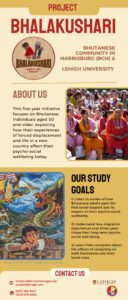
Bhalakushari, an endearing Nepali term meaning “casual conversations,” has become a household word among the Bhutanese community in Central Pennsylvania over the past year. Project Bhalakushari, a research collaboration between Lehigh University and its community partner Bhutanese Community in Harrisburg (BCH), has sparked conversations about dialogue, connection, and healing, centering the often overlooked “50 and above” population in the community.
Bhutanese Community in Central Pennsylvania
Central Pennsylvania is currently home to approximately 50,000 Nepali-speaking Bhutanese.
In the early 1990s, ruling elites in Bhutan brutally persecuted and forcibly expelled ethnic Nepali-speaking southern Bhutanese (Lhotsampas), forcing them into a stateless life in refugee camps in Nepal for decades. The community was later resettled across the Global North, with the United States receiving the largest number of refugees, over 90,000. The largest resettlements occurred in states such as Texas, New York, Indiana, North Carolina, and Georgia. Approximately 20% of those resettled in the U.S. are aged 45 and over.
In recent years, the Harrisburg metro region has attracted secondary migration due to increased job opportunities across education levels, a manageable cost of living, and “landscapes reminding people of home.” As a result, Central Pennsylvania has become one of the most concentrated hubs for Bhutanese communities in the U.S..
What is Project Bhalakushari?
Nearly two decades after resettlement, Project Bhalakushari centers the refugee life experience of the older adults (ages 50 and above) within the community. It explores how experiences of forced displacement and rebuilding life in a new country continue to shape their psychosocial wellbeing today.
The project began in 2017 in Massachusetts and entered its current phase in Pennsylvania in 2024, which will continue through 2029. Built on a 10-year partnership between researchers and Bhutanese communities, the project follows a community-driven approach. It builds on earlier studies in Massachusetts and Canada, led by Dr. Rochelle Frounfelker, Assistant Professor at Lehigh University and Bhalakushari’s Principal Investigator.
Project Bhalakushari uses a Community-Based Participatory Research (CBPR) approach, meaning community members have been involved at every stage, from research design to implementation, taking on different roles throughout the project. The seeds of Bhalakushari were planted during an earlier collaboration between Dr. Frounfelker and BCH Executive Director Tej Mishra, when they worked together to adapt and evaluate interventions addressing Bhutanese child and adolescent mental health in Massachusetts. During that process, community members raised a critical question: “What about our elders? What about their mental health?” That concern became the driving force behind the next phase of the research.
The team expanded its focus on Bhutanese individuals aged 50 and older, first in Massachusetts and Ottawa, Canada.
Community-Driven Research and Goals
Embracing CBPR principles that emphasize equitable partnerships, and trust-building, the Bhalakushari team now includes local community members and leaders as Research Assistants and Community Advisory Board members. This structure allows community members to develop research skills and build long-term community capacity, supporting sustainable impact.
Over five years, the project focuses on three major goals.
First, Bhalakushari is listening to stories of support. How do the older adults in the community find strength and community in a place so different from where they came from? Second, Bhalakushari is trying to understand long-term challenges and resilience. What have their experiences, both before coming to the U.S. and after resettling, meant for their psychosocial wellbeing over time? And third, Bhalakushari wants to learn from caregivers. What’s it like to support someone over 50, and how can the community better support those who do?
Alongside creating a supportive space for the older adults to share their experiences, these goals will inform future programs and support services for aging community members. The project also aims to raise awareness of issues affecting Bhutanese adults over age 50 among community leaders, researchers, and service providers. Additionally, the storytelling component helps preserve cultural and migration histories for future generations.
Why Older Adults?
To understand why the project centers older adults, it is important to reflect on the community’s history. The ethnic Nepali Bhutanese community has endured forced displacement from their homeland, decades in refugee camps in Nepal, and the challenge of rebuilding life in countries like the United States.
That journey of losing one’s home, navigating lives in refugee camps, and starting over in a new country can be deeply traumatic. While it affects all age groups, older adults often carry a distinct burden. They have witnessed more, lost more, and frequently hold memories and grief that have never been fully processed or shared.
Yet most of the mental health research and services prioritize youth and young adults. Aging refugees receive far less attention. According to UNHCR, older individuals make up approximately 8.5% of the total displaced population. Despite this significant number, they are often overlooked by systems, policies, and sometimes even within their own families.
Many older adults experience isolation, even in intergenerational homes where multiple generations live together. Although physically surrounded by family, they may still feel emotionally alone. Language barriers, dependence on others, difficulty accessing healthcare, and feeling misunderstood all contribute to challenges affecting their psychosocial wellbeing.
Importantly, their wellbeing is shaped by a lifetime of displacement, loss, and the struggle to preserve culture and identity in a new environment. These experiences are often left unspoken, and silence can deepen emotional pain. This is where Bhalakushari plays a critical role.
The project also examines what works. When older adults are coping well, what support systems have helped them adapt and thrive? Understanding both challenges and strengths allows the researchers to present a fuller picture of community wellbeing.
What’s Next?
After launching at the end of 2024, Project Bhalakushari engaged the community throughout the year to raise awareness and conducted qualitative interviews with older adults, caregivers, and healthcare providers. These interviews explored experiences of social support within the Central Pennsylvania Bhutanese community.
Beginning in mid-December of 2025, the project launched its quantitative phase, administering surveys to better understand participants’ sense of belonging, cognitive and physical wellbeing, experiences of trauma, hardship and discrimination, and levels of social support.
The project aims to interview 200 older adults (ages 50+), along with a support person who provides them direct and indirect care. This quantitative phase will continue for three years, through 2028 to collect longitudinal data from the same participants.
Through a mix of qualitative and quantitative approach, Project Bhalakushari aims to honor the lived experiences of the community members aged 50 and above, as well as those who support them. In doing so, Bhalakushari’s team of researchers, community members and leaders hope to help shape a future in which the community understands where its people come from, carries their strength forward, and becomes part of a shared journey toward healing.